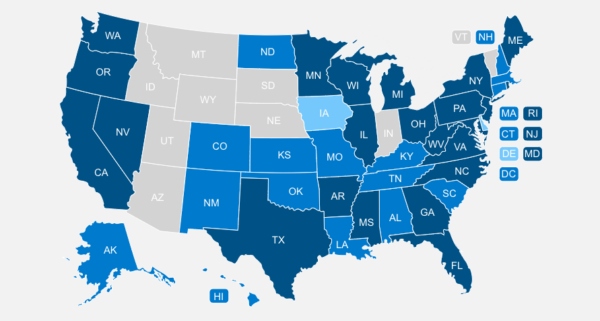
Nonprofit Annual Filing Requirements by State
Utah Nonprofit Annual Filing Requirements: A Step-by-Step Guide
Utah nonprofits must file an annual report with the Utah Division of Corporations and Commercial Code by the anniversary date of incorporation for $18. Starting January 1, 2025, organizations must also upload their Form 990 as part of this filing process.
Introduction
Did you know that failing to meet nonprofit annual filing requirements can result in hefty penalties, loss of tax-exempt status, or even involuntary dissolution of your organization?
For Utah nonprofits, staying compliant isn’t just important—it’s essential to your continued operation! Meeting your annual filing obligations might seem overwhelming at first, but with Labyrinth combining expert service with modern technology, you can certainly navigate these requirements without stress.
Whether you’re managing a small community organization or a larger charitable foundation, understanding your specific filing obligations helps protect your nonprofit status. From IRS Form 990 submissions to Utah state annual reports, each requirement serves a purpose in maintaining your organization’s good standing.
This step-by-step guide specifically addresses the ongoing compliance needs for established Utah nonprofits. You’ll learn exactly what to file, when to file it, and how to avoid common pitfalls that could jeopardize your organization’s future. Let’s ensure your nonprofit remains focused on its mission instead of scrambling to address compliance issues!
Step 1: File IRS Form 990
Filing your annual IRS Form 990 serves as the cornerstone of maintaining your nonprofit’s tax-exempt status. This federal requirement applies to almost all tax-exempt organizations and provides transparency about your organization’s activities, governance, and finances.

Determine which version of Form 990 to file
The IRS requires different versions of Form 990 based on your organization’s financial activity. Selecting the correct form is crucial for compliance:
- Form 990-N (e-Postcard): For organizations with gross receipts normally ≤ $50,000. This eight-question electronic form can be submitted online only.
- Form 990-EZ: For organizations with gross receipts < $200,000 AND total assets < $500,000. This condensed version is about four pages long.
- Form 990: Required if your gross receipts are ≥ $200,000 OR total assets are ≥ $500,000. This comprehensive 12-page return requires detailed financial reporting.
- Form 990-PF: All private foundations must file this form regardless of financial status.
Remember that smaller organizations eligible for Form 990-N can choose to file Form 990-EZ or the full Form 990 if they prefer. Moreover, even if your organization hasn’t formally applied for tax exemption, you’re still required to file if you claim exempt status under section 501(a).
Understand the filing deadlines
Your Form 990 is due on the 15th day of the fifth month after your fiscal year ends. For example:
- If your tax year ends December 31, your form is due May 15
- If your tax year ends June 30, your form is due November 15
Need more time? You can request an automatic six-month extension by filing Form 8868 before your original deadline. This extends only the filing deadline, not any payment due dates.
The following table shows key filing dates for various fiscal year endings:
| Tax Year End | Initial Due Date | Extended Due Date (with Form 8868) |
|---|---|---|
| December 31 | May 15 | November 15 |
| June 30 | November 15 | May 15 |
| September 30 | February 15 | August 15 |
| March 31 | August 15 | February 15 |
If the due date falls on a weekend or holiday, it’s automatically extended to the next business day.
Avoid penalties for late or missed filings
The IRS imposes penalties for late or incomplete Form 990 filings. Penalties generally accrue per day and vary based on an organization’s gross receipts, and amounts are adjusted periodically for inflation. Additionally, failure to file for three consecutive years results in automatic revocation of your tax-exempt status. Reinstatement involves filing all missing returns, paying any applicable penalties, and submitting a new application—a costly and time-consuming process.
While there’s no penalty for late Form 990-N submissions, the three-year automatic revocation rule still applies.
Step 2: Submit Utah Annual Report
Just as important as your federal IRS filings, maintaining compliance with Utah state requirements through annual reporting keeps your nonprofit in good standing. This mandatory filing confirms your organization remains active and provides the state with updated information about your operations.
Know your anniversary date
Utah follows an anniversary-based system for nonprofit annual reports. Your filing deadline falls on the last day of your anniversary month—the month when your organization was originally registered with the state. For instance, if your nonprofit incorporated on April 17, your annual report must be submitted by April 30 each year.
The state allows you to file up to 60 days before your due date, giving you a comfortable window to prepare your materials. Additionally, Utah provides a 30-day grace period after the due date; filings submitted after the deadline are subject to a late fee. Unlike some other states, Utah does not grant extensions for annual report filings.
To verify your specific anniversary date, you can:
- Check your original formation documents
- Run a Utah business search through the Division of Corporations website
- Contact the Utah Division of Corporations (801-530-4849, corporations.utah.gov) directly
Filing methods and fees
Utah offers multiple filing options for your annual report (also called a renewal):
Online Filing: The preferred method through the Utah Division of Corporations and Commercial Code website. You’ll need to:
- Log in with UtahID (or create one if you don’t have an account)
- Select “Renewals” from the left menu
- Search for your entity by name or number
- Follow the step-by-step filing process
Labyrinth handles annual report filings as part of our comprehensive compliance services, managing the entire process and tracking your anniversary date to ensure timely submission.
Paper Filing: Download and complete the form, then mail it to:
Utah Division of Corporations & Commercial Code
Box 146705
Salt Lake City, Utah 84114-6705
The standard filing fee for nonprofit corporations is $18.00. For multiple renewals, you must submit separate payments and forms.
Consequences of non-compliance
Failing to file your annual report on time triggers several consequences:
After the grace period expires, the state imposes a $10.00 late fee. If your nonprofit remains unfiled after the due date, your organization may be marked as “expired”, which can lead to administrative dissolution proceedings.
The consequences of non-compliance extend beyond financial penalties:
- Loss of good standing status
- Inability to access Utah courts
- Risk of administrative dissolution or revocation
- Loss of rights to use your nonprofit’s name
- Damage to your organization’s reputation
Most importantly, banks, lenders, and even potential donors often require verification of good standing status. An expired status can complicate your financial operations and fundraising efforts.
To maintain uninterrupted operations and avoid these penalties, mark your calendar with both your filing deadline and the grace period end date. Creating recurring reminders 60 days before your deadline ensures you’ll never miss this crucial requirement.
Step 3: Maintain State Tax Exemptions
Beyond federal tax exemption and state reporting, maintaining your Utah tax exemptions requires attention to specific state requirements. The Utah State Tax Commission (801-297-2200, tax.utah.gov) oversees two primary exemptions that benefit nonprofits operating within the state.
Sales tax exemption using Form TC-160
To obtain exemption from Utah sales tax, your organization must complete Form TC-160, “Application for Sales Tax Exemption Number for Religious or Charitable Institutions.” Once approved, you’ll receive an “N” number (sales tax exemption number) that allows qualified purchases without paying sales tax.
Primarily, the application process requires:
- Documentation of your 501(c)(3) status through an IRS determination letter
- Information about your organization’s purpose and operations
- Details about potential unrelated business income
You can submit your application online through the Utah Tax Commission’s TAP portal rather than using paper forms. Upon approval, your organization should use the appropriate Utah sales tax exemption certificate provided by the Utah State Tax Commission (for example, Form TC-721) when making qualifying purchases.
Remember that sales tax exemptions apply only to qualifying purchases made for exempt purposes; purchases related to non-qualifying activities remain taxable.

Income tax exemption using Form TC-161
Similarly, exemption from Utah’s corporate franchise or income tax requires filing Form TC-161. Although receiving an IRS determination letter doesn’t automatically exempt you from state taxes, it forms the basis for your application.
To qualify, you must:
- Submit documentation of your federal tax-exempt status
- Select the appropriate exemption class (most commonly IRC §501(c))
- Provide organizational information and documents as requested
There is no filing fee listed on the form; processing times vary. Additionally, incomplete applications often face rejection or delays, so thoroughness is essential.
Like sales tax exemptions, corporate tax exemptions don’t apply to unrelated business activities. Consequently, if your organization generates such income, you may still owe taxes on those specific earnings.
When to update exemption status
Although Utah doesn’t require annual renewal applications for either sales or corporate tax exemptions, maintaining current information with the state remains vital. Nevertheless, you must update your exemption status whenever:
- Your organization’s address changes
- Officers or leadership positions change
- Your federal tax-exempt status changes
- Your organization’s name or structure changes
The Utah State Tax Commission (801-297-2200) can provide guidance on updating this information. Since missing communications from tax authorities may result in compliance issues, keeping your contact details current protects your exempt status.
Rather than dealing with reinstatement complications, make updating your exemption information part of your routine whenever organizational changes occur. Generally, providing timely updates helps maintain seamless tax-exempt operations.
Step 4: Update Registered Agent and Contact Info
Keeping your nonprofit’s registered agent information up-to-date represents another crucial annual compliance requirement. This designated point of contact serves as the official liaison between your organization and government authorities, making accurate information essential for ongoing operations.
Why registered agent info must be current
Maintaining current registered agent information safeguards your nonprofit in several critical ways. First and foremost, your registered agent receives all official legal documents, including service of process for lawsuits and important tax notices. Once listed, your agent’s address becomes public record in Utah’s business database.
Failing to maintain accurate agent information carries serious consequences:
- Missing important legal deadlines due to undelivered documents
- Default judgments in lawsuits you never knew existed
- Loss of good standing with the state
- Reduced ability to secure loans or contracts
- Fines and penalties for non-compliance
An often overlooked fact: even if you use a registered agent service, Utah law ultimately holds you—the business owner—responsible for compliance.
How to update your agent with the state
Whenever your registered agent information changes, you must promptly notify the Utah Division of Corporations. You can complete this process through several methods:
The most efficient approach is updating online through the Division’s website. You’ll need:
- Your entity number
- A UtahID account
- The new agent’s information
- Payment method for the applicable state filing fee
Processing times vary by method, and online filing is generally the fastest option.
Additionally, you can review and update your information during your annual renewal as needed. Labyrinth manages registered agent updates as part of our comprehensive filing services, ensuring all changes are properly documented with the state.
Avoiding missed legal notices
To prevent missed communications, consider these practical strategies:
First, immediately inform your previous agent when making a change to ensure they redirect any documents they receive. Throughout this transition, maintain clear communication with both old and new agents.
Second, regularly verify your agent information during annual report preparation. This simple step helps catch outdated information before it causes problems.
Third, consider the benefits of a professional registered agent service. Such services offer consistent availability during business hours, protecting your privacy since your personal address won’t appear in public records. Furthermore, professional agents understand compliance requirements, provide timely document forwarding, and send compliance reminders.
Finally, remember to update your IRS contact information as well. Exempt organizations must report address changes on their next annual return (Form 990, 990-EZ, or 990-N) or by filing Form 8822-B.
Step 5: Prepare for 2025 Filing Changes
Starting January 1, 2025, Utah is implementing significant changes to nonprofit annual filing requirements that demand your attention now. These modifications streamline the process yet introduce important new documentation responsibilities.
New requirement to upload IRS Form 990
Beginning January 1, 2025, Utah-registered nonprofit corporations must include unredacted copies of their most recent IRS Form 990s with annual corporate filings. This replaces the previous requirement to register separately with the Division of Consumer Protection. As part of the state’s effort to simplify compliance, this consolidation streamlines the process through the Division of Corporations and Commercial Code (DCCC).
Primarily, you’ll upload your Form 990 through one of these methods:
- During your annual report/renewal submission
- When initially registering as a domestic or foreign nonprofit entity
Importantly, when completing the renewal, you must answer two questions: whether your organization is a “charitable organization” as defined in Utah Code 13-22-2, and if you have an IRS Form 990 filing requirement.
What charities are affected
This requirement applies exclusively to:
- Nonprofit corporations incorporated in Utah
- Foreign nonprofit corporations registered to do business in Utah
Organizations exempt from filing Form 990 with the IRS remain exempt from this state requirement. Furthermore, organizations not incorporated or registered in Utah as foreign nonprofit corporations are not obligated to submit Form 990s to the state.
The rule affects all types of charitable organizations using any version of Form 990, including 990-EZ, 990-N, or 990-PF. Notably, brand-new nonprofits without a filed Form 990 during their first year will upload it with their first annual renewal.
How to stay ahead of the changes
Ultimately, complying with these requirements prevents possible fines under Utah’s Charitable Solicitations Act. Subsequently, prepare by:
- Ensuring your nonprofit is properly registered with DCCC (entities receive numbers ending in “-0140 or -0141”)
- Making clean copies of your Form 990 without:
- Form 990 Schedule B
- Form 8879
- Social Security Numbers or PIN numbers
- Marking your calendar for January 1, 2025, especially if your renewal date falls early in the year
The uploaded Form 990 becomes public record, as the DCCC serves as a repository on behalf of the Division of Consumer Protection. In effect, anything included will be available for public inspection, thereby making proper document preparation essential.
For organizations managing multiple filing responsibilities, Labyrinth handles the new 2025 Form 990 upload requirement alongside your annual report submission, ensuring all documents are properly prepared and submitted on time.
Conclusion
Maintaining compliance with annual filing requirements undoubtedly protects your Utah nonprofit’s status and ensures your organization continues serving its mission without interruption. As you’ve seen throughout this guide, each filing serves a specific purpose in keeping your nonprofit legally operational and in good standing, making nonprofit compliance essential for your continued success.
First and foremost, timely submission of your IRS Form 990 safeguards your federal tax-exempt status. Accordingly, selecting the correct form version based on your organization’s size and filing it by the deadline prevents penalties and the potentially devastating automatic revocation that occurs after three missed years.
Equally important, your Utah Annual Report confirms your nonprofit’s active status with the state. Therefore, marking your anniversary month on your calendar and submitting the required information helps avoid the $10 late fee, expired status, and possible administrative dissolution that could otherwise occur.
Additionally, maintaining your state tax exemptions through proper documentation with the Utah State Tax Commission ensures your organization retains its valuable sales and income tax benefits. While these exemptions don’t require annual renewal, updating your information whenever organizational changes occur prevents complications down the line.
Your registered agent serves as your nonprofit’s official point of contact, consequently making accurate information crucial for receiving legal notices and important documents. Updating this information promptly whenever it changes protects your organization from missed deadlines and potential default judgments.
Finally, preparing now for the 2025 filing changes will certainly make your transition smoother when the time comes. The new requirement to upload your unredacted Form 990 with your annual filings streamlines the process but demands careful preparation.
For nonprofits seeking guidance through these requirements, working with experienced compliance specialists can ensure accuracy and timeliness across all filings. Remember that compliance isn’t just about avoiding penalties—it’s about maintaining your nonprofit’s reputation and ability to fulfill its purpose. By following this step-by-step guide and creating a compliance calendar for your specific deadlines, you can focus your energy on your mission rather than scrambling to address preventable issues.
Your nonprofit’s work is too important to be derailed by missed filings or compliance problems. After all, staying on top of these requirements might take some effort, but the alternative—losing your tax-exempt status or good standing—presents a far greater challenge than simply filing the right forms at the right time.
Frequently Asked Questions