Your Giving Tuesday Donate Button Doesn’t Stop at Your State Line
October 19, 20265 State Registration Checks to Make Before Giving Tuesday 2026

A national campaign can trigger charitable registration rules in every state it reaches, not just your home state. Use this five-step checklist to check your own records before December 1, 2026. If you find a gap now, you still have time to close it.
Step 1: Map Where Your Giving Tuesday Campaign Will Actually Reach Donors
Online is the obvious one: your donate button, email list, social posts, and Giving Tuesday page. But direct mail, event invitations, phone appeals, and peer-to-peer fundraising pages can all count as asking too. Write down each one.
Then check where each reaches. Look at the states in your email list and your social followers, and everywhere your Giving Tuesday page will be shared or advertised. Your real reach isn't your office address. It's wherever your donors are, and for most nonprofits with any national reach, that list is longer than the states where they first registered.
Step 2: Compare That List Against Your Current Registrations
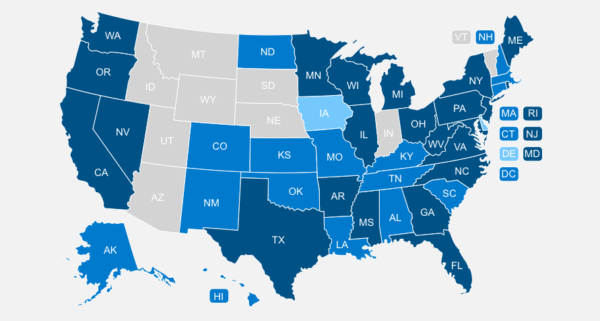
Check the states where your campaign reaches donors against Labyrinth's 50-State Fundraising Compliance Guide and your own registration list.
Most registration lists show history, not today. They show where a nonprofit started or where an old campaign focused, not where donors are now. A gap here is usually a sign of growth. It's not a mistake.
Step 3: Check Renewal Status, Not Just Whether You Ever Registered
A lapsed registration protects you no better than never registering at all.
Renewal deadlines vary by state. Many are tied to your fiscal year-end. New York, for example, sets its renewal deadline at 4.5 months after your fiscal year ends.
If your last renewal lapsed, treat that state the same as one where you've never registered.
Step 4: Check Disclosure Requirements, Not Just Registration
Registration and disclosure are two different rules.
Labyrinth's state guide shows that 24 states require specific wording on solicitation materials, often including your donation page itself. You can be fully registered in a state and still break its disclosure rule if your Giving Tuesday page is missing the required wording.
Step 5: Know What the Charleston Principles Do (and Don't) Cover
The Charleston Principles offer some protection for online gifts, but not full protection.
In states that follow them, a nonprofit registered and in good standing at home doesn't need to separately register for online-only gifts from that state.
But this protection is narrow. It only covers online solicitation. Not every state follows it. And it doesn't replace a state's disclosure rules. Think of it as one check on your list, not the only one.
What This Means for Your Organization
A full check of your registration, renewal, and disclosure rules isn't hard on its own. The risk is rushing through it under time pressure, not any single step being difficult.
Finding no problems is a good outcome. It means your coverage matches your reach, and you know that before donations start arriving.
Finding a gap means one thing: act on the timeline right away. Registration approval isn't instant. In some states, it can take several weeks. A gap found in October can still be fixed before December 1. A gap found the week of the campaign usually can't.
How Labyrinth Can Help
Checking every state by hand is easy to put off and expensive to skip.
Labyrinth's managed registration service tracks registration, renewal, and disclosure rules in every state, all year. It also flags disclosure-wording changes, so your donation page doesn't fall out of date. You don't have to remember to check. We already are.
Contact us today to find out where your nonprofit stands before December 1.