
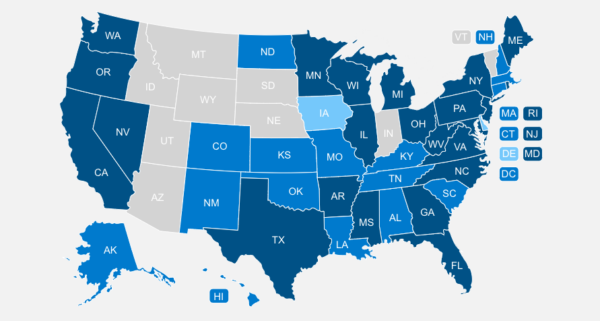

Cause Marketing and Commercial Co‑Venture by State: Essential Registration Requirements Guide
Cause-Marketing and Commercial Co-Venture in New Mexico: Essential Registration Requirements Guide
At a Glance
New Mexico does not require traditional registration for commercial co-venturers, unlike approximately 24 other states that explicitly regulate these business-charity partnerships. Your business can launch charitable sales promotions without submitting registration forms or paying fees to state authorities. However, you must maintain proper documentation with partner charities and ensure transparent disclosure of donation amounts in all promotional materials.
Are you considering a commercial co-venture partnership with a charity in New Mexico? These strategic partnerships between businesses and charitable organizations can significantly boost your brand image while supporting important causes. When your business promises to contribute a portion of sales to charity, you’re engaging in a commercial co-venture that resonates with socially conscious consumers.
However, before launching your campaign, you need to understand New Mexico’s specific requirements. The state regulates these partnerships to protect consumers and charitable organizations alike. Additionally, proper compliance helps you avoid potentially costly penalties that could harm both your reputation and bottom line.
Throughout this guide, you’ll discover exactly who needs to register as a commercial co-venturer in New Mexico, what exemptions might apply to your situation, and the step-by-step process. Furthermore, you’ll learn about essential contract requirements, disclosure obligations, and ongoing responsibilities. By following these guidelines, you’ll ensure your charitable marketing campaigns remain both effective and compliant with New Mexico state regulations.
Who Needs to Register as a Commercial Co-Venturer in New Mexico
Understanding commercial co-venture regulations in New Mexico requires familiarity with state-specific definitions and requirements. Unlike many other states, New Mexico takes a distinct approach to regulating these business-charity partnerships.

Definition of Commercial Co-Venture under NM Stat. § 57-22-1
The legal framework for commercial co-ventures in New Mexico falls under the Charitable Solicitations Act (Chapter 57, Article 22 NMSA 1978). Although the Act doesn’t explicitly define commercial co-ventures, these arrangements typically involve for-profit businesses that promote how purchasing their products or services will benefit a charitable organization or purpose. For instance, a retail store might advertise that a percentage of each purchase will be donated to a specific charity.
A commercial co-venturer is generally understood as a business primarily engaged in trade or commerce for profit that conducts charitable sales promotions. These promotions connect consumer purchases directly to charitable contributions, creating a three-way relationship between consumers, businesses, and nonprofit organizations.
Activities That Trigger Registration Requirements
Surprisingly, New Mexico does not currently maintain traditional registration requirements for commercial co-venturers. This stands in contrast to approximately twenty-four states and the District of Columbia that explicitly regulate commercial co-ventures.
Nevertheless, this absence of formal registration does not mean your business can operate without regulatory oversight. Certain activities might still trigger other compliance obligations. For instance, if your promotion involves soliciting direct contributions rather than donating a portion of sales, you could potentially fall under different regulatory categories.
To avoid misclassification, carefully structure your promotional language. Specifically, avoid phrasing that suggests consumers are making direct contributions to charities through your business. Instead, clearly communicate that the business itself will make the donation based on consumer purchases.
Distinction Between CCVs and Fundraising Counsel
The distinction between commercial co-venturers and other fundraising entities is crucial for compliance purposes. Professional fundraisers in New Mexico include persons who:
- Solicit or direct others to solicit contributions from the public
- Work on behalf of charitable organizations for compensation
- Have custody or control of the contributions
In contrast, commercial co-venturers typically do not directly solicit charitable donations nor take possession of contribution funds. Instead, they promise to contribute a portion of their sales proceeds to charitable organizations.
Another important distinction concerns financial relationships. Professional fundraisers and fundraising counsel generally receive payments directly from charitable organizations, whereas commercial co-venturers usually do not receive financial consideration from the charities they support.
Although formal registration might not be required, other regulatory considerations still apply. While some states mandate specific contract terms between businesses and charities, New Mexico does not require CCV-specific contract filing. Nonetheless, clear disclosures about donation amounts and terms in promotional materials are advisable to avoid deceptive practices under general consumer protection laws.
Ultimately, despite the lack of formal registration requirements, your commercial co-venture still needs proper documentation, clear promotional language, and adherence to broader consumer protection regulations to operate legally in New Mexico.
Exemptions from Commercial Co-Venture Registration
Because New Mexico does not require a traditional commercial co-venturer registration, exemptions are primarily relevant to the charitable organization’s registration obligations under the Charitable Solicitations Act. Understanding these exemptions can still help with compliance planning when selecting nonprofit partners.
Religious and Educational Organization Exemptions
The Charitable Solicitations Act provides clear exemptions for religious organizations. These are defined as “a church, organization or group organized for the purpose of divine worship or religious teaching or other specific religious activity.” This exemption extends to organizations formed primarily to encourage, support, or promote the work of churches or religious groups (see the New Mexico Attorney General charities guidance).
Educational institutions likewise enjoy exemption status under New Mexico law. The Act defines an educational institution as “an entity organized and operated primarily as a school, college or other instructional institution with a defined curriculum, student body and faculty, conducting classes on a regular basis” (see the New Mexico Attorney General charities guidance).
Auxiliary entities receive similar exemptions. These include:
- Parent-teacher organizations
- Booster clubs
- Support groups
To qualify, these entities must support, encourage, or promote a school or other educational institution, its curriculum, student body, faculty, facilities, or activities (see the New Mexico Attorney General charities guidance). Essentially, if your commercial co-venture partnership involves exclusively these types of organizations, you may benefit from simplified compliance requirements.
One-Time or Low-Volume Fundraising Exceptions
The financial scope of fundraising activities sometimes determines exemption eligibility in other states. In New Mexico, exemptions are prescribed by statute for specific categories (such as religious and certain educational organizations) rather than by general small-dollar thresholds. Review the statutory exemptions carefully to determine whether your charitable partner is exempt from charitable registration requirements.
Direct-to-Beneficiary Campaigns and Exemption Criteria
Direct-to-beneficiary campaigns represent another potential exemption category in New Mexico’s charitable registration framework. Under state law, solicitations made on behalf of a specifically identified individual or group (for example, after a medical or other catastrophe) can be exempt when the gross contributions, without deductions, are deposited directly into an account in the name of that individual or group at a local federally insured financial institution and used solely for the direct benefit of the named beneficiary.
Finally, bear in mind that exemption from registration requirements differs fundamentally from federal tax-exempt status. A charity’s tax-exempt status under IRC Section 501(c)(3) does not automatically exempt it from state-level registration and reporting obligations related to charitable solicitation. When CCV activity occurs across multiple states, nonprofit partners should understand that charitable solicitation registration requirements may apply in different jurisdictions.
Initial Process for Commercial Co-Venturers
Navigating the regulatory landscape for commercial co-ventures in New Mexico differs notably from requirements in other states. While many states maintain strict protocols, New Mexico takes a more streamlined approach.
Required Forms and Where to File
Contrary to practices in states like Alabama, California, Massachusetts, and South Carolina, New Mexico does not currently require a traditional registration process for commercial co-venturers. This absence of formal registration requirements represents a significant departure from the approximately 24 states that explicitly regulate commercial co-ventures.
Consequently, businesses planning charitable sales promotions in New Mexico need not submit specific commercial co-venturer registration forms or pay associated fees. This contrasts sharply with states such as:
- Alabama ($100 registration fee)
- California ($500 registration fee)
- Massachusetts ($200 registration fee plus a surety bond)
- South Carolina ($50 registration fee)
Instead, your primary focus should be on contract documentation with partner charities and ensuring compliance with broader consumer protection regulations. For businesses operating in multiple states where CCV requirements do apply, we can help navigate varying state regulations and filing obligations efficiently.

Information Needed for Documentation
Notwithstanding the absence of a dedicated commercial co-venturer registration requirement, businesses should maintain comprehensive documentation of their charitable partnerships. Typically, this includes:
- A written agreement between your business and the charitable organization clearly outlining:
- Compensation structures
- Authority granted to the business
- Campaign details including timeframes
- Solicitation methods and locations
- Complete financial records documenting:
- Gross proceeds from the promotion
- Net amounts donated to the charity
- Methods for calculating charitable contributions
Certainly, the charitable organizations themselves must register with the New Mexico Department of Justice (505-717-3500, nmdoj.gov) before soliciting funds in New Mexico. These nonprofits complete registration through the New Mexico Charitable Organization Registration Online System (NM-COROS).
Timeline and Turnaround Expectations
In terms of timing considerations, the absence of a formal registration process eliminates many of the standard waiting periods observed in other states. Subsequently, this allows businesses to implement charitable sales promotions more rapidly, provided proper documentation exists between the business and charity.
Yet, businesses should recognize that partner charitable organizations face their own timeline constraints. Specifically, these organizations must register with the New Mexico Department of Justice before soliciting funds or within thirty days of creation even if not actively soliciting.
For these charitable partners, registration through NM-COROS requires:
- Answering all questions and providing complete information
- Uploading required documents including IRS Form 1023/1024, articles of incorporation, and by-laws
- Submitting IRS Form 990 with all attachments
Overall, the streamlined approach in New Mexico benefits businesses looking to launch commercial co-ventures with minimal regulatory hurdles. Primarily, this allows you to focus on creating meaningful charitable partnerships without the administrative burden of extensive registration processes.
Indeed, this simplified regulatory framework represents one of New Mexico’s business-friendly approaches. Meanwhile, businesses should remain vigilant about maintaining proper documentation and ensuring their charitable partners fulfill their own registration obligations to maintain full compliance.
Contract and Disclosure Requirements
Even with New Mexico’s streamlined approach for commercial co-ventures, proper documentation remains essential for legal compliance. While New Mexico does not require CCV-specific registration or contract pre-filing, you should still ensure appropriate agreements and accurate public disclosures to avoid misleading consumers.
Written Agreement Requirements Between CCV and Charity
Best practice is to have a written contract forming the foundation of any commercial co-venture relationship in New Mexico. A properly structured agreement should contain:
- Names of both the nonprofit organization and for-profit company
- Identification of charitable purposes benefiting from the campaign
- Detailed description of co-venture activities and geographic scope
- Campaign timeframe with specific start and end dates
- Estimated number of units expected to be sold
- Terms for using the nonprofit’s name and marks
- Method for calculating donation amounts (percentage, fixed amount, etc.)
- Schedule and process for transmitting contributions
- Requirements for financial reporting and accounting
These written agreements protect all parties involved in the co-venture by establishing clear expectations prior to campaign launch. We can provide guidance on contract elements and state-specific requirements to help ensure agreements meet compliance standards while protecting both business and charitable interests.
Submission of Contracts to NM Attorney General
Unlike states such as Hawaii, New Jersey, and South Carolina that require commercial co-venturers to file contracts with state authorities before campaign launch, New Mexico currently does not mandate pre-filing of commercial co-venture agreements with the Attorney General’s office.
In essence, this places greater responsibility on the commercial co-venturer and charity to self-regulate through comprehensive contractual arrangements. Coupled with this flexibility comes the obligation to maintain thorough records that could be requested by regulatory authorities if questions arise about the promotion.
Disclosure of Donation Amounts and Terms in Promotions
Transparency in promotional materials constitutes a crucial element of commercial co-venture compliance. To avoid deceptive practices, clearly disclose how consumer purchases translate into charitable contributions. Rather than vague language like “a portion of proceeds,” specify exact figures whether a percentage of sales or fixed dollar amount per purchase.
Additional disclosure best practices include:
- Clearly stating the charity’s name and mission
- Specifying campaign start and end dates
- Disclosing any maximum donation caps
- Explaining any consumer actions required to trigger donations
- Making information accessible across all promotional channels, including social media
Given these points, transparency serves both regulatory compliance and consumer trust. General consumer protection laws prohibit deceptive practices in charitable sales promotions, so clear disclosures are both wise and protective.
In conclusion, commercial co-venturers operating in New Mexico should prioritize detailed written agreements and transparent promotional disclosures, establishing a solid foundation for successful charitable marketing campaigns.
Annual Renewal and Financial Reporting Obligations
Maintaining compliance after initial setup differs for businesses and charities in New Mexico. New Mexico does not impose annual renewal or financial reporting obligations on commercial co-venturers. However, charitable organizations partnering in these campaigns have ongoing filing requirements through NM-COROS.
Renewal Timeline and Due Dates
Charitable organizations must submit their annual financial reports to the New Mexico Department of Justice within six months following the close of their fiscal year. This timeline is automatically calculated and displayed on the organization’s registration homepage in NM-COROS. If additional time becomes necessary, organizations may request a six-month extension through the online portal, provided the request occurs before the original due date.
Required Attachments: IRS Form 990, Financial Statements
Renewal filings by charitable organizations demand specific documentation:
- Organizations with less than $50,000 in total revenue should submit the appropriate IRS 990 electronic postcard
- Organizations with total expenses over $750,000 must perform an independent audit and submit it electronically
- Additional required attachments include a list of officers and directors plus professional fundraising contracts
Penalties for Late or Incomplete Renewals
Charitable organizations face a $100 penalty for:
- Failure to file annual reports by the deadline
- Neglecting to request an extension before the due date
Above all, charities that miss renewal deadlines must also submit updated entity formation and tax documents, creating additional administrative burden.
Frequently Asked Questions

Conclusion
Throughout this guide, you’ve gained valuable insights into New Mexico’s distinctive approach to commercial co-ventures. Unlike many states with rigorous registration protocols, New Mexico offers a more streamlined process, thus eliminating traditional registration requirements for commercial co-venturers. Nevertheless, this simplified framework doesn’t diminish your responsibility to maintain proper documentation and transparency.
Your business should establish comprehensive written agreements with partner charities that clearly outline campaign details, donation calculations, and promotional timeframes. Additionally, consumer-facing materials should provide transparent disclosure of exact donation amounts rather than vague references to “portions of proceeds.” These practices protect both charitable organizations and consumers while building trust in your promotional campaigns.
Charitable partners face their own registration obligations through the New Mexico Charitable Organization Registration Online System before soliciting funds. Therefore, verifying your nonprofit partner’s compliance status becomes an essential step in your due diligence process. For multi-state campaigns, nonprofits may need charitable solicitation registrations in additional jurisdictions where CCV activity occurs.
For charitable organizations, annual financial reporting through NM-COROS is due within six months following the fiscal year end, with penalties of $100 applying to late or missed filings. Prudent businesses will coordinate with their charitable partners to calendar these deadlines well in advance to avoid unnecessary complications.
Commercial co-ventures offer powerful opportunities to enhance your brand while supporting worthy causes in New Mexico. We assist with organizing contracts, filing materials, and documentation, helping partners stay compliant across different jurisdictions when campaigns extend beyond state borders. Adherence to these state-specific requirements ensures your charitable marketing campaigns remain both legally compliant and ethically sound.
